Key points at a glance
- A fixed Imbiss is a fixed-location business with a trade registration under § 14 GewO; if you travel around without prior orders, you generally need a Reisegewerbekarte under § 55 GewO.
- For a pitch on public land, you need a Sondernutzungserlaubnis (street-use permit); at markets and festivals, you need the organiser's approval.
- Food and non-alcoholic drinks are licence-free under § 2 (2) GastG; to serve beer, you need a licence, a temporary permit (Gestattung) or a notice.
- The IfSG briefing (under the Infection Protection Act), HACCP and registration with the food inspection authority apply in the truck too.
- Electronic tills need a TSE; with your own ordering page, you save the commission charged by delivery platforms.
This post is general information and does not replace legal or tax advice. Rules change and some differ between federal states: check the details with your chamber of commerce (WKO) or IHK, the competent authority or your tax adviser.
Fixed Imbiss or food truck?
An Imbiss in a shop unit or a permanent kiosk works legally like a small restaurant: trade registration, building law for the premises, food inspection and, if you have seating, hospitality law. A food truck or sales trailer is more flexible but needs its own permit for every location and must meet hygiene requirements in a tight space. Many start with a truck at markets and events and open a fixed location later. Whether the rent for a fixed location will pay off is shown by the break-even calculator: it works out how many guests you need per day.
- Fixed Imbiss: predictable customers, delivery possible, but rent and often conversion costs for extraction and a grease separator.
- Food truck: lower fixed costs, events and catering, but pitches, weather and vehicle costs.
- Catering: delivery to order from your own kitchen, legally usually a fixed-location business.
Trade registration or Reisegewerbekarte
If you start a fixed-location business (stehendes Gewerbe), meaning you work from a fixed establishment, you register it with the trade office under § 14 GewO (Gewerbeordnung, the Trade Regulation Act). This applies to an Imbiss in a shop unit and to catering to order. By contrast, under § 55 (1) GewO, you run an itinerant trade (Reisegewerbe) if you sell goods or offer services outside your establishment without a prior order; for this, under § 55 (2) GewO, you generally need a Reisegewerbekarte.
The Reisegewerbekarte has important exceptions in § 55a GewO. Among others, no card is needed if you occasionally sell at trade fairs, exhibitions or public festivals with the permission of the competent authority (no. 1), or if you offer food from a mobile sales point at regular, short intervals at the same spot (no. 9). If you trade at established markets such as weekly markets or annual fairs, you fall under the market rules of the Gewerbeordnung. The trade office will tell you which option fits your route plan.
| Model | Trade law | Typical permit for the pitch |
|---|---|---|
| Imbiss in a shop unit | Trade registration (§ 14 GewO) | Building permit for the use, if needed a street-use permit for outdoor tables |
| Food truck, changing locations without orders | Reisegewerbekarte (§ 55 GewO), unless an exception applies | Street-use permit per location or contract with a private landowner |
| Food truck, fixed weekly schedule at the same spots | Exception under § 55a (1) no. 9 GewO possible | Street-use permit per location |
| Market, funfair, street food festival | Market rules or exception under § 55a (1) no. 1 GewO | Approval by the organiser or municipality |
| Catering to order | Trade registration (fixed-location business) | No pitch permit, but a kitchen at your business address |
Pitches, street-use permits and private land
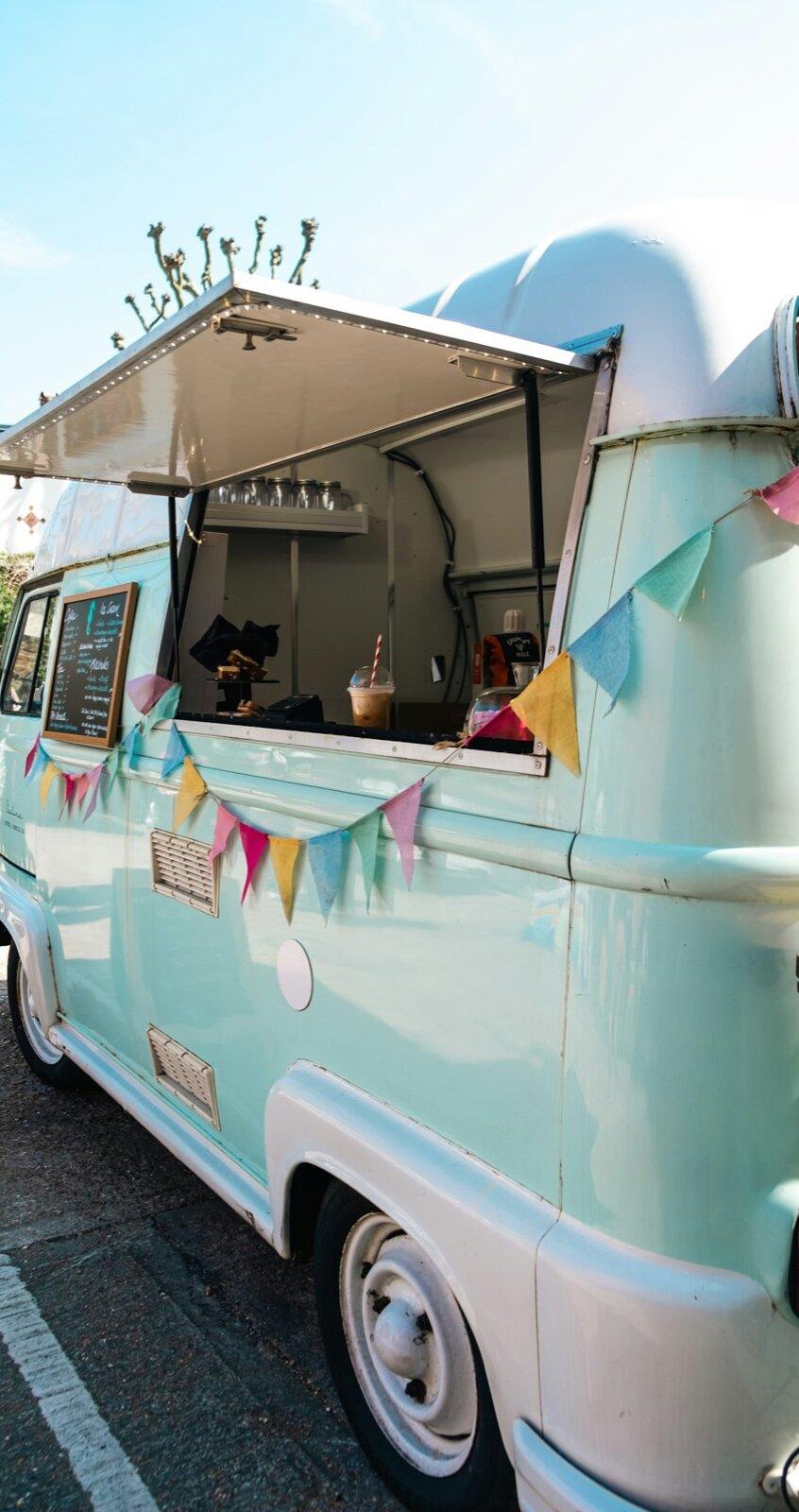
The best truck is no use without a pitch. On public streets and squares, selling counts as special use (Sondernutzung), for which you need a Sondernutzungserlaubnis under your state's road law and the municipality's bylaws. Many cities only allocate a limited number of pitches, on certain weekdays or through tenders. On private land, such as a supermarket car park or company premises, you sign a contract with the owner; depending on the duration, a building permit may still be required.
Hospitality law, hygiene and food inspection
The good news: if you only offer prepared food and non-alcoholic drinks, you need no Gaststättenerlaubnis (restaurant licence) under § 2 (2) GastG. Under § 1 (2) GastG, an itinerant trade also counts as a restaurant business if it operates from a fixed site for the duration of an event. If you want to sell beer with your burgers, depending on the state you need a licence, a Gestattung under § 12 GastG (temporary permit) for festivals, or a notice. Details in our guide to the Gaststättenerlaubnis.
Hygiene is especially critical in a snack bar: fat, meat, sauces and little space. You and every employee need the certificate under § 43 IfSG, which may be no more than three months old when work starts. You run a HACCP self-monitoring system with temperature logs for cooling and cooking, and your business must be registered with the food inspection authority (Lebensmittelüberwachung). For food trucks, the authority at your business address is usually responsible; it inspects the vehicle, water supply, hand basin and cold chain.
Before your first day of trading
- Trade registration or Reisegewerbekarte in hand
- Pitch permit or contract for every location
- IfSG certificates for the whole team
- Registration with the food inspection authority, HACCP logs in the vehicle
- Fresh and waste water tanks, hand basin, cooling with thermometer
- Fire extinguisher and inspected gas system if you cook with gas
- Allergen list and price list clearly visible at the serving hatch
Till with TSE: in a food truck too
Germany does not yet have a cash register obligation; an open cash box with a daily cash report is allowed. If you use an electronic till or a tablet till, however, it must be secured with a certified TSE (technical security device) under § 146a AO (the Fiscal Code), issue receipts and be reported to the tax office within one month of purchase. There are no exceptions for mobile businesses; an exemption from the receipt obligation is only possible on application to the tax office.
Online ordering without platform commission
Lieferando, Wolt and foodora bring reach but take a noticeable commission on every order. For a snack bar with small margins, that quickly eats up the profit. Your own ordering page for pickup and local delivery, linked to your Google profile, brings regular customers back from the platform. How to combine platforms and your own channel sensibly is covered in our guide to delivery platforms.
How to get it right
- Menu with prices and allergens on your own website
- Offer pickup at a chosen time to ease the lunchtime rush
- Add a flyer with your ordering page to platform deliveries
- Collect catering enquiries through your own form
Better not
- Charge more on the website than in the shop without saying so clearly
- Be reachable only through one platform
- Offer the menu as a PDF that cannot be read on a phone
- Publish phone numbers that nobody answers at lunchtime
Concept and vehicle
Decide on dishes, prices and equipment, have the truck or trailer fitted out to meet hygiene requirements and get the gas system inspected. The menu price calculator turns food cost and markup into selling prices.
Trade registration or itinerant trade
Check with the trade office whether a trade registration, a Reisegewerbekarte or an exception under § 55a GewO fits, and submit the documents.
Hygiene and registration
Obtain IfSG certificates, create HACCP logs and register the business with the food inspection authority.
Secure pitches
Apply for street-use permits, sign contracts for private land and apply for markets and festivals.
Till and online presence
Set up and report the TSE till, and put your website with menu and weekly schedule, plus your Google profile, online before the first day of trading.
Keep locations and opening hours up to date online
For food trucks, the most important question from guests is: where are you today? A weekly schedule on your website, a pinned Instagram post and current times in your Google Business Profile answer it. With the opening hours generator, you can create opening times and Google posts in a few minutes; announce changing locations as a post or event. A fixed Imbiss should also be listed correctly in map services such as Google Maps and OpenStreetMap.
Examples of snack bar websites
This is what websites for snack bars, döner shops, burger joints and food trucks with menu, weekly schedule and ordering look like.
Your own ordering page instead of commission
Free preview of your snack bar website with menu, locations and ordering, at a fixed price of €1,800.
A free preview of your venue website, designed by us.