Key points at a glance
- Baking yourself or buying in is not a matter of principle: many cafés combine two or three house classics with gateaux from a good patisserie.
- A small, clear range sells better than a crowded, confusing display. Better to restock than to thin out.
- Chilling and hygiene belong in your own food safety checks: check and record temperatures, note when a cake was cut, and treat cream and custard gateaux differently from dry cakes.
- Allergen information must be available for unpackaged cakes too, documented in writing for every variety, including the ones you buy in.
- Pricing per slice and a simple sales log show which cakes pay off and how much you should really bake or order.
This post is general information and does not replace legal or tax advice. Rules change and some differ between federal states: check the details with your chamber of commerce (WKO) or IHK, the competent authority or your tax adviser.
Bake yourself or buy in?
The first decision shapes your whole café: do the cakes come from your own kitchen, from a patisserie down the road or from a wholesaler with frozen goods? Homemade cakes are a strong selling point and often cheaper in ingredient cost, but they take working time, space, equipment and skill. Bought-in gateaux are predictable and consistently good, but the margin is lower and you become interchangeable if the café next door orders from the same supplier.
| Model | Pros | Cons | Suits |
|---|---|---|---|
| Bake everything yourself | Own profile, low ingredient cost, flexible varieties | Lots of working time, bakehouse needed, trade law to clarify | Cafés with a pastry chef or a bakery café |
| Buy in from a patisserie | Consistent quality, little effort, professional look | Lower margin, lead times, little exclusivity | Small cafés, start-up phase, coffee bars |
| Frozen goods from a wholesaler | Long shelf life, thaw portions as needed | Quickly feels generic, guests notice the difference | Add-on, peak times, emergency stock |
| Mix | House classics plus bought-in gateaux | Two workflows, two kinds of allergen records | Most cafés |
If you bake yourself, check the trade rules first. Austria and Germany have their own rules for bakers and pastry chefs, and not every cake from your own recipe turns your café into a craft business. What applies is explained in Opening a café in Austria and Opening a café in Germany. Binding answers come from the WKO (Austrian Chamber of Commerce) in Austria and the Handwerkskammer (chamber of crafts) or IHK in Germany.
The right range for your display
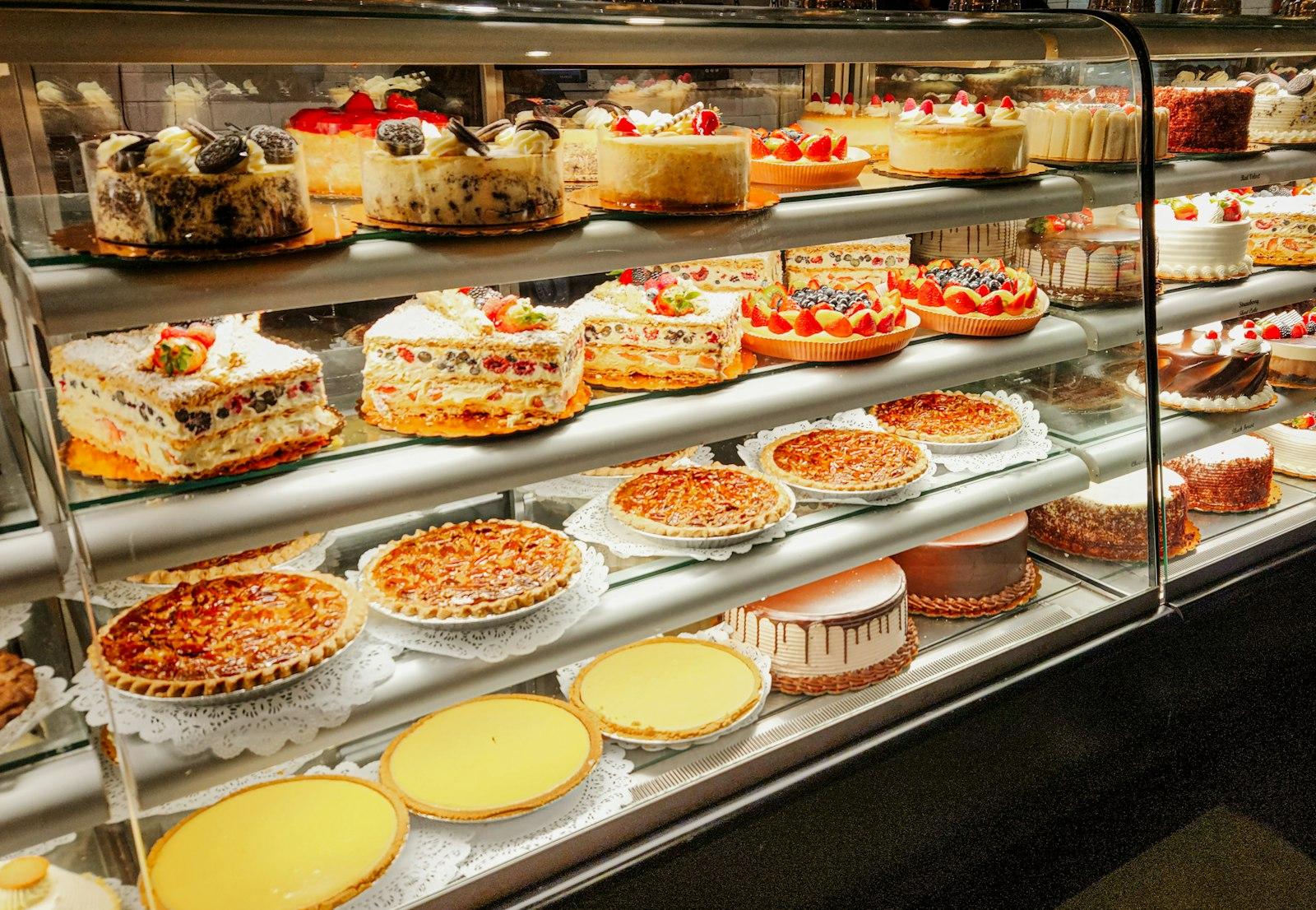
A good display has something for every taste without overwhelming anyone. For a small to medium café, six to ten varieties are usually enough. The mix matters more than the number: something fruity, something chocolatey, a classic, a cake without cream for warm days and at least one option for guests who avoid gluten, dairy or animal products.
- Classics: apple strudel, Sachertorte, cheesecake or Topfentorte, marble cake. They sell every day.
- Seasonal: rhubarb in spring, strawberries and apricots in summer, plums in autumn, gingerbread and nuts in winter.
- Dry cakes: pound cake, Gugelhupf, brownies. They keep longer and need less chilling.
- Cream and custard gateaux: high price per slice but short shelf life. Only as many as you are sure to sell.
- Vegan, gluten-free, less sugar: one or two well-made options rather than many half-hearted ones.
Don't change varieties at random. Regulars love their favourite cake, new guests enjoy a seasonal slice. A fixed core plus one or two rotating varieties a week has proven itself in many cafés.
Presenting the display
Guests decide within seconds, and they decide with their eyes. A well-stocked, well-lit display sells cake even to guests who only wanted a coffee. A half-empty display with cut leftovers, on the other hand, looks like the end of the day, even at eleven in the morning.
How to get it right
- Show whole gateaux and cut them only when needed
- Same cakes side by side, bestsellers at eye level
- Small labels with name, price and allergen codes for each variety
- Clean the glass several times a day and remove crumbs and leftovers at once
- Close up empty spaces so the display looks full
Better not
- Twenty varieties crammed into a small space
- Dried-out cut surfaces turned towards the guest
- Handwritten notes nobody can read
- Yesterday's cakes placed between fresh ones without a note
- A display in full sun or next to the radiator
The display doesn't end at the counter. Many guests check online first to see what's on today. An up-to-date photo of the display on your Google profile or Instagram and a “Cakes and gateaux” page on your website bring guests into the café. Take the photos in daylight, from slightly above and with clean glass, ideally right after restocking.
Chilling and hygiene
Not all cakes are the same. Dry pound cakes, strudel or brownies are far less sensitive than gateaux with cream, custard, quark, cream cheese or fresh fruit. These products need chilling, and the chilling has to work reliably, even on a hot summer day with the door open. Which temperatures apply to which product is set out in your suppliers' instructions, in the industry's hygiene guidelines and in your own food safety plan based on HACCP principles.
The legal basis in both countries is EU food hygiene law, above all Regulation (EC) No 852/2004. In Germany it is supplemented by the Lebensmittelhygiene-Verordnung (LMHV, food hygiene ordinance), in Austria by the Lebensmittelsicherheits- und Verbraucherschutzgesetz (LMSVG, food safety act). Practical help comes from the guidelines for good hygiene practice offered by the WKO and DEHOGA for hospitality, and from hygiene courses at WIFI or the IHK.
Hygiene around the cake display
- Check and record the temperature of the chilled display every day
- A thermometer inside the display, not just the reading on the unit
- Note the cutting date or production date for each gateau
- Cream and custard gateaux chilled only, never for hours on the counter
- A separate cake server and knife for each variety, changed regularly
- Handle cakes only with tongs, a server or gloves, never with bare hands
- Clean the display and cake plates thoroughly on a regular basis
- A clear rule for when a cut cake comes off sale
Allergens in cakes and gateaux
Cakes almost always contain several of the 14 major allergens: gluten, eggs, milk, often nuts such as hazelnuts or almonds, sometimes soy, sesame or lupin. Under the EU Food Information Regulation (FIC, in German LMIV), guests must be told about allergens for unpackaged food too. How exactly this works differs by country: read the details in Allergen labelling in Austria and Allergen labelling in Germany.
Record recipes
Write down every ingredient of each house cake, including decoration, glaze and filling.
Get supplier information
For bought-in gateaux, request allergen information in writing and update it whenever a variety changes.
Labels and folder
Put allergen codes on the label of each variety or keep an allergen folder at the counter that your team knows.
Keep online in sync
If the cake appears on your website or in your digital menu, the allergens belong there too.
Create a consistent key for your menu, display labels and website with the Allergen legend. Watch out for cross-contact: one cake server for all varieties quickly turns a nut-free cake into one with traces of nuts.
Pricing per slice
Many cafés copy the cake price from a competitor and are surprised at the end of the month. Calculate per slice instead: the ingredient cost of the whole gateau divided by the number of slices you actually sell, not the number you could theoretically cut. Breakage, tastings and leftovers belong in the calculation.
| Step | Example | Note |
|---|---|---|
| Ingredient cost of the whole gateau | 12 euros | All ingredients or the supplier's price |
| Slices per gateau | 14 | Cut evenly, a cake divider helps |
| Loss through leftovers and cutting | 2 slices | From your own sales log, not guessed |
| Ingredient cost per slice sold | 1 euro | 12 euros divided by 12 slices sold |
| Target food cost | 25 to 30 percent | Your own benchmark, depending on concept and costs |
| Net price per slice | about 3.40 to 4 euros | Plus VAT, then round sensibly |
If you bake yourself, add working time, energy and equipment, which are not part of the ingredient cost. If you buy in, the ingredient cost is higher but you save time. Note also that VAT can differ for eating in and taking away; check this with your tax adviser. The Price calculator works out the selling price from ingredient cost, target share and VAT.
What should a slice of gateau cost?
Enter the ingredient cost per slice, choose a target share and you're done: the Price calculator works out the selling price including VAT for Austria and Germany.
Avoiding leftovers
Every cake thrown away at night eats into the margin of the slices you sold. The most important lever is a simple sales log: for each day and variety, note how many slices were sold and how many were left. After a few weeks you will see patterns by weekday, weather and season and can bake or order more precisely. Many till systems provide these figures automatically.
- Stagger instead of everything in the morning: two gateaux early, the third only when the first is almost gone.
- Dry cakes as a buffer: they keep longer and fill the display in the afternoon.
- Present smaller later in the day: move leftovers together and don't cut a new gateau.
- Sell day-old cakes openly: where hygiene allows, at a lower price and clearly labelled.
- Pass it on: apps against food waste or donations to charities.
More on production planning, day-old goods and key figures in the guide Reducing returns and food waste.
Whole cakes to order
Whole cakes for birthdays, christenings, company parties or weddings are a rewarding extra business: predictable, no leftovers and often at a higher price than selling by the slice. For it to work, guests need clear information: which cakes are available, in which sizes, with what lead time and how to order.
Define the range
A small cake menu with photos, sizes (for example 12 or 16 slices) and prices. How much batter, cream and filling the larger cake needs is worked out from your base recipe by the recipe scaler.
State the lead time
Around two to three days for standard cakes, longer for custom designs and around holidays. How to take requests for custom and wedding cakes with a form and a deposit is shown in Online cake requests.
Offer a way to order
Phone, a form on your website or WhatsApp, with all the details needed at a glance.
Deposit and pickup
Agree a deposit for large cakes and write down pickup time and name.
How to organise pre-orders and pickup, especially at Easter and Christmas, is covered in Pre-orders and click & collect. A dedicated “Order a cake” page on your website is found for searches like “order cake” plus your town and saves you many phone calls.
Show your cakes online
See in the free preview how your café could look on its own website, with your cake range, cake menu and allergens.
A free preview of your venue website, designed by us.
Sources
- Regulation (EC) No 852/2004 on the hygiene of foodstuffs (EUR-Lex, German)
- Lebensmittelhygiene-Verordnung (LMHV, German food hygiene ordinance)
- WKO Vorarlberg: food hygiene, hygiene practice and HACCP principles in hospitality
- Regulation (EU) No 1169/2011 (FIC, EUR-Lex, German)
- WKO hospitality association: allergen labelling of food