Key points at a glance
- A stock count records what is actually there. Only the variance check against the sales from your till shows how much stock has disappeared without revenue.
- Count your top items weekly and the whole stock monthly, always at the same time, in a fixed order, with open bottles measured in tenths or on scales.
- Jiggers and fixed recipes are the most effective lever against shrinkage: every serve is the same size and can be traced in the till.
- Free drinks, staff drinks, breakage and tastings must be rung up. Unrecorded usage looks exactly like theft in your figures.
- A fixed ordering rhythm with minimum stock levels and a few key figures such as cost of goods ratio and shrinkage rate are enough for a one-hour month-end review.
This post is general information and does not replace legal or tax advice. Rules change and some differ between federal states: check the details with your chamber of commerce (WKO) or IHK, the competent authority or your tax adviser.
Why stock counts matter so much in a bar
In the kitchen, ingredients are processed; in the bar, stock is sold almost unchanged. On the one hand that makes the bar very profitable: a long drink or a glass of wine usually has a much lower cost of goods than a main course. On the other hand, stock in a bar is easy to give away, spill or take home. A bottle of spirits is small, valuable and opened in seconds. If you only look at your bank balance, you notice losses only once they have added up over months.
A stock count answers three questions: How much stock do we have? How much should we have according to purchases and sales? And where does the difference come from? This is not about distrusting your team. Most variances come from missing entries in the till, inaccurate pouring and wrong recipes stored in the till system. All of that can be fixed with clear routines. A bar with a short menu can often manage with a spreadsheet, while a club with several bars and high volumes needs fixed counting zones and a till with stock management.
Stock count: step by step
A stock count is only as good as its repeatability. If someone different counts at a different time in a different order every time, the numbers cannot be compared. So define a fixed routine and write it down.
Fix the time
Always count after closing and before the next delivery, for example on Monday morning. Nothing may be sold or delivered between the count and the till report.
Set counting zones
Storeroom, fridges, back bar, speed rail and every additional bar are separate zones. The count sheet follows the order in which the bottles actually stand.
Count full units
Unopened bottles, crates and kegs are recorded as whole units. Open crates and check that they really are full.
Record open bottles
Estimate open bottles in tenths or weigh them. For weighing, note the empty and full weight of each bottle once.
Count in pairs
One person counts, the other writes. If there are large variances, the zone is counted a second time straight away.
Pull the till report
Right after the count, print or export the sales report for the period since the last stock count.
There are several methods for open bottles. What matters is that you pick one and stick with it. Draught beer is the hardest to record: weigh kegs if possible and allow for a dispensing loss for foam and line cleaning that you have measured in your own venue.
| Method | How it works | Suitable for |
|---|---|---|
| Estimating in tenths | Note the fill level by eye in steps of 0.1 | Small bars, few products, quick weekly count |
| Weighing | Put the bottle on kitchen or bar scales, calculate the content from empty and full weight | Expensive spirits, accurate monthly count |
| Inventory app with scales | The app knows the bottle weights and transfers the stock automatically | Clubs and bars with many products and several bars |
| Weighing kegs or flow meters | Weight or dispensed volume instead of an estimate | Venues with a high share of draught beer |
Variance check against till data
The real insight comes from the comparison. Expected stock is opening stock plus deliveries minus usage according to the till. Actual stock is what you counted. The difference is your shrinkage. For the till to know the usage, every item needs a stored recipe: 4 cl of gin and 20 cl of tonic for a gin and tonic, 0.125 l for a small glass of wine, 0.5 l for a large beer. How to set up such recipes and the prices that go with them is explained in the guide to drinks menus and cocktail costing.
| Item | Quantity | Explanation |
|---|---|---|
| Opening stock | 6.0 bottles | Counted at the last stock count |
| Deliveries | + 12.0 bottles | According to delivery notes |
| Sales according to till | – 160 drinks × 4 cl = 6.4 l = 9.1 bottles | Usage from the recipes |
| Expected stock | 8.9 bottles | What should be there |
| Actual stock | 7.6 bottles | Counted today |
| Variance | – 1.3 bottles (about 23 drinks) | Shrinkage that needs explaining |
Always convert the variance into money and lost sales as well. “1.3 bottles” sounds like little; 23 unsold gin and tonics sound different. Your team understands that language better too. Analyse the variance per item, not just in total: a surplus of one product and a shortfall of another often point to items rung up incorrectly, for example when the premium gin is entered in the till as the house gin.
Where shrinkage comes from and how to spot it
Shrinkage almost always has several causes at once. Before you suspect individuals, check your routines. The following overview helps you read patterns in your figures.
| Cause | Typical pattern | Countermeasure |
|---|---|---|
| Over-pouring without a jigger | Small, even shortfall across all open spirits | Jiggers or measured pourers, train the recipes |
| Free drinks not rung up | Shortfall in popular drinks, often after events or at weekends | Dedicated till buttons for treats and staff drinks |
| Wrong items entered | Surplus of the cheap product, shortfall of the expensive one | Simplify the till layout, name items clearly |
| Breakage and spoilage | Single whole bottles missing, open wines going off | Breakage log at the bar, plan wine-by-the-glass volumes |
| Delivery errors | Variance right after delivery days | Check deliveries against the delivery note on arrival |
| Theft | Shortfall in expensive, easy-to-sell bottles, depending on the shift | Lock the storeroom, key responsibility, count per shift |
A certain amount of shrinkage cannot be avoided, for instance through evaporation, drips or a spilled glass. What matters is knowing your own normal level. If the variance suddenly rises, it pays to look closely: which items, which bar, which days? Shrinkage also affects your bookkeeping. In Germany, an electronic till system must record every transaction without gaps (see till systems with TSE), and in Austria the cash register obligation applies. Sales that bypass the till are therefore not only a costing problem but also a tax problem.
Pour sizes, jiggers and recipes
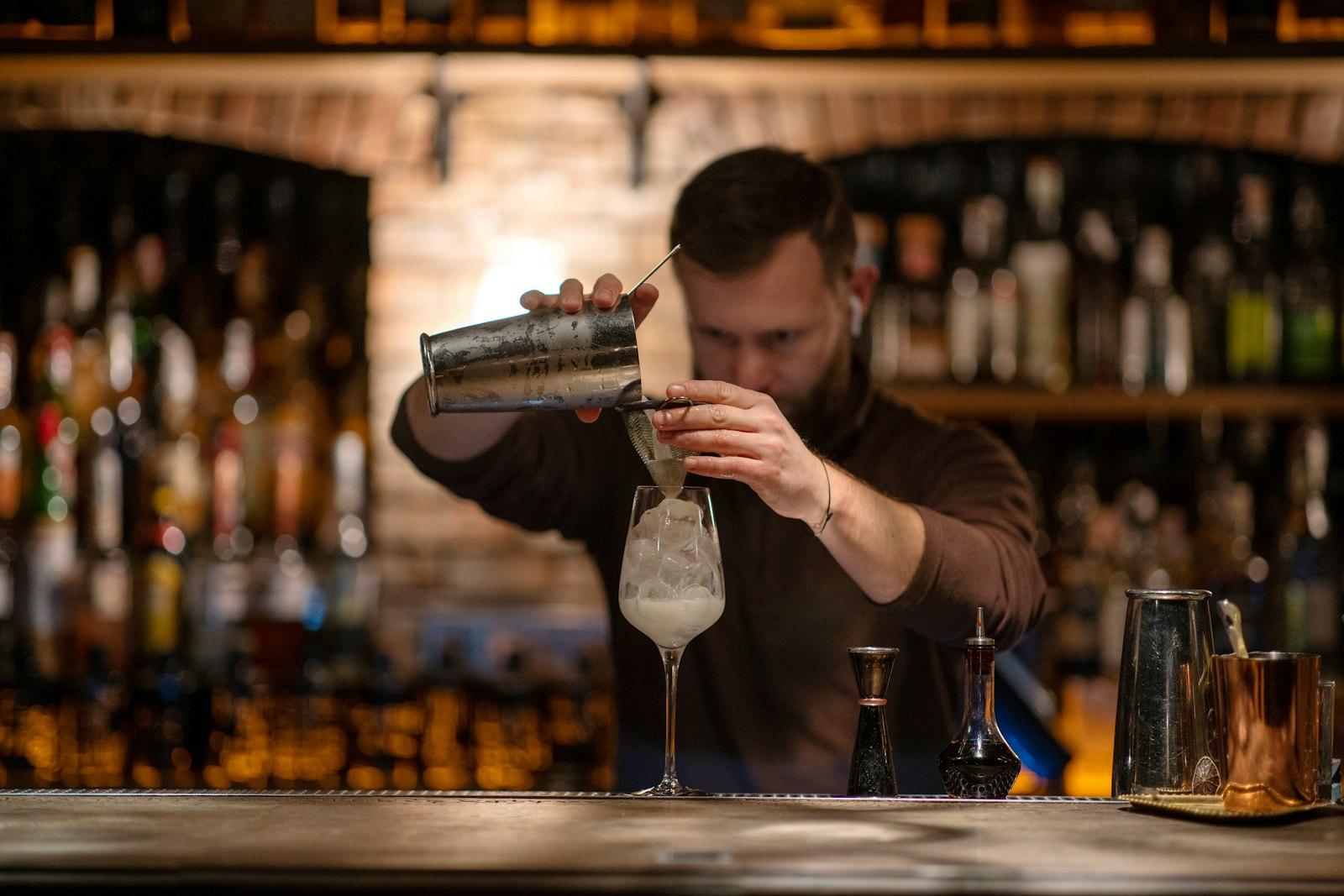
The biggest single lever against shrinkage is an accurate pour size. Free pouring tends to mean more rather than less in daily practice, especially under stress or for regulars. Just a few millimetres extra per glass add up over hundreds of drinks a week. A jigger (a measuring cup, for example with 2 and 4 cl) or pourers with portion control make sure every serve is the same size. That is good not only for your cost of goods but also for your guests: a cocktail then tastes the same every night. What one extra centilitre per glass costs you is shown by the drinks price calculator: it works out the cost per serve from bottle price and pour size.
The quantity stated on the menu must actually end up in the glass. Serving glasses and measures are subject to legal metrology rules: in Germany in the Mess- und Eichverordnung (measurement and calibration ordinance), in Austria in the Maß- und Eichgesetz and its ordinances. These include permitted nominal volumes and fill lines. Buy glasses and carafes with fill lines from a specialist supplier who confirms the marking, and if in doubt ask the calibration authority, the WKO in Austria or the IHK in Germany.
How to get it right
- Set a fixed standard pour for every spirit and store it in the till
- Provide jiggers at every station, even during the rush
- Display recipe cards for signature drinks at the bar
- Coach new staff on pouring during their first shifts
- Keep double serves as a separate item in the till
Better not
- Pour by eye because it is faster
- See an “extra splash” as customer loyalty
- Change recipes without updating the till
- Use glasses without fill lines for drinks with a stated quantity
- Blame shrinkage on the team without checking routines
Recording free drinks, staff drinks and breakage
A shot on the house, a beer for the band, tastings with a supplier, a drink for staff after their shift: all of this is fine as long as it is recorded. Unrecorded usage cannot be told apart from theft in a stock count and distorts your costing. So decide who may give out what, and make recording it as easy as possible.
- Dedicated till buttons for “guest treat”, “staff drink”, “artist/DJ”, “tasting” and “breakage”, each with a price of zero but with a recipe, so the usage is deducted from stock.
- Clear rules: for example one staff drink per shift, treats only by the shift manager, drinks for DJs as agreed.
- Breakage log at the bar: date, item, quantity, initials. Keep empty or broken bottles briefly until the shift manager has seen them.
- Analyse events separately: for happy hours, free drink vouchers or drinks packages for groups, ring up the usage separately. Ideas for such nights are in the guide to events in the bar.
- Returns and empties to the supplier recorded with a receipt, so credits are not counted as deliveries.
How staff drinks and treats are handled for tax purposes, for example as a benefit in kind or as an advertising expense, differs between Austria and Germany and depends on the individual case. Have your tax adviser explain it to you once and set up the till buttons accordingly.
Storage and ordering rhythm
A tidy storeroom is the basis for a quick stock count. And a fixed ordering rhythm prevents both empty shelves on a Friday night and too much money tied up in bottles that sit for months.
- Fixed places: every product has a labelled spot, in the storeroom and on the back bar in the same order as on the count sheet.
- Restrict access: the main storeroom is locked, the bar is restocked from it each shift and this is recorded in writing.
- Minimum and maximum stock for each item: when stock falls below the minimum, reorder up to the maximum.
- Fixed ordering day to match the delivery days of wholesalers, breweries and wine merchants, for example count on Monday, order on Tuesday, delivery on Thursday before the weekend.
- First in, first out: new stock to the back, older stock to the front, especially for beer, juices, syrups and open wines.
- Check slow movers: offer bottles that have not sold for months as a special or remove them from the range.
In clubs especially, usage varies widely from weekend to weekend. So plan orders around your event calendar: a sold-out club night needs different stock from a quiet Thursday. Use the price calculator to work out what a drink should cost based on your cost of goods.
Price your drinks correctly
Enter the cost of goods per drink, choose a target ratio and the VAT for Austria or Germany: the price calculator shows the right selling price.
Key figures for the month-end review
You do not need controlling software to run your bar. A few key figures, calculated the same way every month and compared over time, reliably show whether something is getting out of hand. The trend in your own venue matters more than any target value from the internet. How cost of goods and contribution margin fit together across the whole business is explained in the guide to costing in hospitality.
| Key figure | Calculation | What it shows |
|---|---|---|
| Cost of goods | Opening stock + purchases – closing stock (in euros, net) | What you actually used |
| Drinks cost of goods ratio | Cost of goods ÷ net drinks revenue × 100 | Whether prices and pouring match |
| Shrinkage rate | Expected minus actual stock in euros ÷ cost of goods × 100 | How much stock disappears without revenue |
| Stock turnover | Cost of goods ÷ average stock value | How often your stock turns over per period |
| Days of stock | Stock ÷ usage per week | How many weeks your stock will last |
| Drinks revenue per guest | Drinks revenue ÷ number of guests or admissions | How well menu and service sell |
Bar stock count checklist
- Fixed counting day and time, before the next delivery
- Count sheet in the order of storeroom and back bar
- Method for open bottles agreed (tenths or scales)
- Recipes for all items stored in the till
- Till buttons for treats, staff drinks, tastings and breakage
- Jiggers at every station, standard pours trained
- Deliveries checked against the delivery note on arrival
- Minimum and maximum stock per item, fixed ordering day
- Variance check per item, difference in euros and drinks
- Key figures updated monthly in the same spreadsheet
A well-run bar also needs a website that brings guests in on quiet nights: a current drinks menu as text, an event calendar, opening hours and group bookings. The free preview shows what your site could look like.
Your bar website in a free preview
See in a few minutes how your bar's drinks menu, events and opening hours look on a website of your own.
A free preview of your venue website, designed by us.