Key points at a glance
- AI assistants don't make up recommendations out of thin air: they rely on your website, map profiles, reviews and mentions across the web.
- Text beats PDF and photos: menu, opening hours and highlights have to be real text on your website so machines can read them.
- Clear facts in full sentences answer exactly the questions guests ask the AI: vegan, terrace, dogs, step-free access, card payment, booking.
- Google profile, Apple Business and reviews are often the most important source for voice assistants and map answers.
- There is no secret AI trick: according to Google, AI Overviews need neither special files nor special markup, just good, consistent content.
This post is general information and does not replace legal or tax advice. Rules change and some differ between federal states: check the details with your chamber of commerce (WKO) or IHK, the competent authority or your tax adviser.
How guests look for a venue today
The classic search for “restaurant Linz” still exists, but new paths are opening up: guests type whole questions into ChatGPT or Perplexity, see an AI Overview above Google's results or talk to Siri or Gemini while sitting in the car. The questions get longer and more specific. Instead of “pizza Vienna” it becomes “pizzeria in Vienna's Neubau district with outdoor seating that also has gluten-free pizza”.
For your business this means: the AI picks the few venues it names and sums up in one sentence what you stand for. Whether that sentence is right depends on what the AI finds about you. The basics of local visibility on Google are covered in the guide Local SEO for hospitality; this one is about what counts on top of that for AI answers.
| Service | Where the information comes from | What you maintain |
|---|---|---|
| Google AI Overviews and AI Mode | Google's search index, Google Maps and Business Profiles | Website, Google Business Profile, reviews |
| ChatGPT (search) | Its own search crawler (OAI-SearchBot) and other search and map sources | A website crawlers can reach, listings on platforms |
| Perplexity | Its own crawler (PerplexityBot), links sources in the answer | A website with clear texts, mentions in media and portals |
| Siri and Apple search | Apple Maps, Applebot, data from Apple Business | Apple Business listing, website |
| Gemini | Google Maps, Business Profiles, Google Search | Google Business Profile, opening hours, website |
Where AI answers get their data
Modern AI assistants usually don't answer questions about venues from their training knowledge alone; they search the web live for current sources. To do so, providers send out their own programs (crawlers) that read websites: Google uses Googlebot, OpenAI uses OAI-SearchBot for ChatGPT search, Perplexity uses PerplexityBot and Apple uses Applebot for Siri, Spotlight and Safari. On top of that come map data, business profiles, review platforms and editorial mentions.
- Your own website: the most reliable source for cuisine, menu, location, opening hours and highlights, because only you control it.
- Maps and profiles: Google Business Profile, Apple Maps, Tripadvisor and business directories supply address, opening hours, category and photos.
- Reviews: the content of reviews feeds into summaries, such as “known for homemade pasta, often busy at weekends”.
- Mentions: articles in city magazines, restaurant guides, food blogs and tourism portals give the AI context and credibility.
Website text instead of PDF and photos
The most common reason an AI describes a venue wrongly or not at all: the key information only exists in a PDF, a photo of the chalkboard or an Instagram post. Machines can read some of it, but unreliably, and a PDF from 2023 quickly contradicts what you offer today. If your vegan bowl only appears in a photo, the chatbot can't find it when someone asks for a vegan lunch.
Google itself names the same basics for its AI features as for normal search: pages must be indexable, important content should be available as text, and structured data has to match the visible content. How to build a menu as text that guests and search engines can both read is explained in the guide on the digital menu.
How to get it right
- Menu as HTML text with dishes, short descriptions and prices
- Opening hours, rest days and holiday closures as text, reachable from every page
- An “About us” page with cuisine, where your produce comes from and your story in full sentences
- Separate pages for lunch menu, breakfast, parties or catering
- Remove old promotions and past events
Better not
- Menu only as a PDF or a phone photo of the chalkboard
- Important information only in Instagram stories or on Facebook
- Text inside images, sliders or embedded flyers
- Slogans without facts such as “the best in town”
- Leaving outdated prices and opening hours on subpages
Clear facts guests ask about
AI assistants answer very specific questions. For your venue to make the shortlist, the matching facts have to be stated clearly on your website. Generic phrases like “cosy atmosphere and friendly service” hardly help. What helps are verifiable statements: “terrace with 40 seats, covered”, “dogs welcome, water bowl ready”, “all dishes also gluten-free on request”.
| Guests ask about | How it reads clearly on the website |
|---|---|
| Sitting outside | “Pavement terrace with 30 seats, open from April to October” |
| Diet | “Three vegan mains every day, allergens marked on the menu” |
| Children and families | “High chairs, kids' menu and baby changing table available” |
| Accessibility | “Step-free entrance, accessible toilet on the ground floor” |
| Paying | “Card payment and Apple Pay from the first euro” |
| Booking and groups | “Book online, groups of up to 25 in the side room” |
| Getting here | “Two minutes from the underground station, car park opposite” |
A good place for such facts is a short FAQ page or an FAQ section on the home page, phrased the way guests ask: “Can we sit outside?” The answer follows in one clear sentence. Make sure the same details are also stored in your Google profile, which has its own attributes for outdoor seating, accessibility or vegetarian options.
Profiles, reviews and mentions
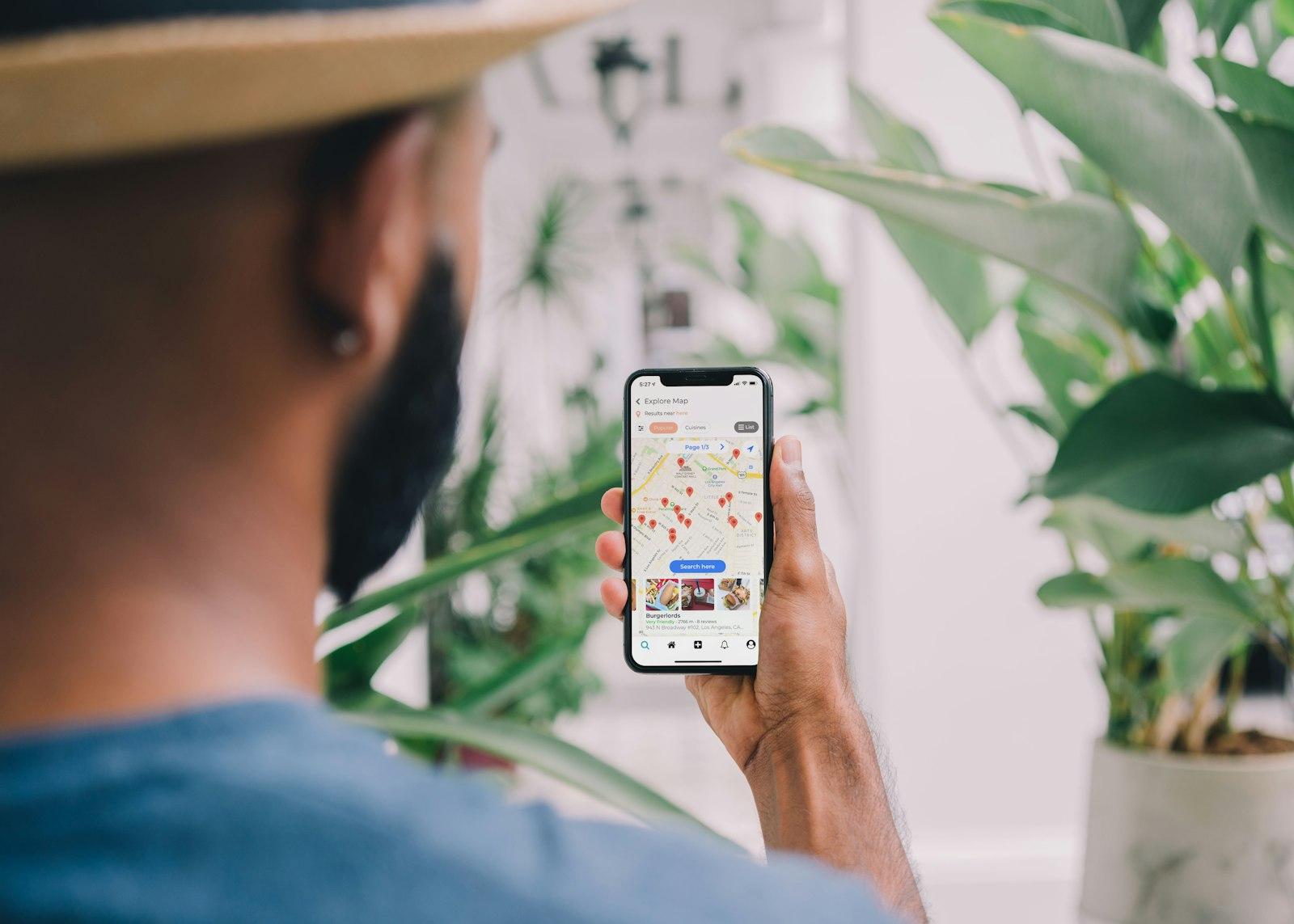
Voice assistants usually answer “Hey Siri, where can I get breakfast nearby?” straight from map data. That's why your listing in Google Maps and Apple Maps is at least as important as your website. A complete Google Business Profile with an exact category, current opening hours, photos and attributes is the foundation. For iPhone users you maintain your listing via Apple Business (formerly Apple Business Connect), as described in the guide on Apple Maps.
Reviews work twice: stars and count influence whether a venue is named, and the text of the reviews shapes how the AI describes it. If many guests praise the “best Kaiserschmarrn around”, that often shows up in the answer. How to ask fairly for genuine reviews and respond calmly to criticism is explained in the guide on Google reviews. Add to that listings in directories and portals, which the AI reads as extra confirmation; which ones are worth it is covered in the guide on business directories.
Align your details
Write name, address, phone and opening hours exactly the same everywhere: website, Google, Apple, platforms. The opening hours generator for Google and your website gives you one consistent format.
Complete your profiles
Add category, attributes like terrace or Wi-Fi, photos, menu link and booking link to every profile.
Collect reviews
Ask all guests equally for an honest review and reply to every one. A QR code for Google reviews on the table makes asking easier.
Prompt mentions
Tell the city magazine, tourism board, restaurant guides and partner businesses about your news.
Structured data and the technical basics
Structured data following schema.org describes your venue in machine-readable form in the background of the page: type (for example Restaurant, CafeOrCoffeeShop, BarOrPub or Hotel), address, opening hours, cuisine, price range and a link to the menu. Google makes clear that AI Overviews need no special markup. Still, structured data helps your details to be read unambiguously and without contradictions. What matters is that it exactly matches the visible text. Details are in the guide on structured data.
The technical basics also include a website that loads quickly, works well on a phone and doesn't hide important content behind cookie banners, pop-ups or logins. For guests from abroad an English version pays off, because many ask their assistant in their own language.
How to check your visibility in AI answers
AI visibility can't be measured as precisely as a Google ranking, because answers change with the wording, location and time. A regular self-test, however, quickly shows you where wrong or missing information about your venue is circulating.
Ask like a guest
Write down five typical questions, such as “Where can I have breakfast on Sundays in Innsbruck?” or “Which inn in Regensburg has a hall for 60 people?”, using your own town.
Test several services
Ask the questions in ChatGPT, Perplexity, Google Search and to Siri or Gemini on your phone.
Note the answers
Are you named? Are opening hours, cuisine and highlights correct? Which sources does the answer link to?
Fix the source
Correct wrong details where they come from: on your website, in your profile or in the directory concerned.
Repeat regularly
Repeat the test every few months and after every bigger change, such as new opening hours or a new menu.
How does an AI recommend your venue?
The free AI preview simulates a chatbot answer and shows which details your venue still lacks to be mentioned more often.
With the AI preview you can see in a few minutes which signals make a recommendation more likely, free and without signing up.
AI visibility checklist
- Menu, opening hours and highlights as text on the website
- Clear facts on terrace, diet, children, accessibility, payment and booking
- FAQ section with questions phrased the way guests ask them
- Google Business Profile complete, attributes maintained
- Apple Business set up
- Name, address, phone and opening hours identical everywhere
- New, genuine reviews on a regular basis, each one answered
- Structured data matching the visible content
- Search crawlers such as Googlebot, OAI-SearchBot and PerplexityBot not blocked
- Self-test in ChatGPT, Perplexity, Google and Siri every few months
A website people and machines understand
Menu as text, structured data and clear facts come as standard with us. Take a look at a free preview for your venue.
A free preview of your venue website, designed by us.