Key points at a glance
- The BaFG has applied since 28 June 2025 to e-commerce services, meaning websites and apps through which consumers conclude a contract.
- For venues, this mainly concerns online ordering with payment, voucher shops, room booking and very probably online reservations. A purely informational website with menu and opening hours is, according to the prevailing view, not covered.
- Micro-enterprises with fewer than 10 employees and no more than 2 million euros in turnover or balance sheet total are exempt for services.
- If you are covered, you need an accessible implementation following WCAG and EN 301 549, as well as accessibility information under Annex 3 BaFG.
- Enforcement by the Sozialministeriumservice (Federal Office for Social Affairs and Disability); fines of up to 80,000 euros, for SMEs up to 50,000 euros.
This post is general information and does not replace legal or tax advice. Rules change and some differ between federal states: check the details with your chamber of commerce (WKO) or IHK, the competent authority or your tax adviser.
What the Accessibility Act regulates
The Barrierefreiheitsgesetz (BaFG, BGBl. I No. 76/2023) implements EU Directive 2019/882, the European Accessibility Act. It has applied since 28 June 2025 and covers an exhaustive list of products and services, mainly in business with consumers (B2C). For hospitality, only one item on this list is really relevant: e-commerce services (Dienstleistungen im elektronischen Geschäftsverkehr).
The law defines them in § 3 Z 27 BaFG as services provided at a distance, electronically via websites and mobile applications, at the individual request of a consumer with a view to concluding a consumer contract. So what matters is not whether you have a website, but whether guests can conclude a contract with you through the website or app.
Which hospitality services are affected
| Service on website or app | Covered? | Reason |
|---|---|---|
| Online ordering with payment (pickup or delivery) | Yes | Classic distance contract |
| Voucher shop, online shop for delicatessen, wine or cooking classes | Yes | Web shop for consumers, expressly covered according to the WKO |
| Room booking at a hotel or guesthouse | Yes | The WKO expressly names booking portals and booking processes |
| Online table reservation with deposit or credit card guarantee | Very probably | Contract with a payment function; the WKO counts online booking tools in general |
| Online table reservation without payment | Probably | A reservation is also an agreement with the guest; treat it with caution |
| Ticket sales for events, brunch or wine tastings | Yes | Contract concluded with payment |
| Purely informational website: menu, opening hours, directions, phone number | Probably not | No contract is concluded via the website |
| Contact form or enquiry for parties without booking | Probably not | Initial contact; the contract is concluded later by phone or email |
| Ordering only via delivery platforms | Primarily the platform | The platform runs the ordering process; your own website remains an informational site as long as it only links to the platform |
In case of doubt, it is not the whole website that is covered but the service: the ordering, booking or shop process, including everything guests need for it, such as the menu within the ordering process, basket, form, login, payment and confirmation. A menu that only informs is not in itself a contract. As soon as guests can order from it, it becomes part of the ordering process.
If you embed an external reservation or ordering system, such as OpenTable, TheFork, Quandoo, resmio or aleno, ask the provider for its accessibility statement. If the guest concludes the contract with you, you remain responsible, even if the widget comes from a service provider. How to choose reservation tools sensibly is shown in our guide to online reservations; the difference between your own ordering and platforms is explained in the guide to delivery platforms.
Exemption for micro-enterprises
Under § 6 (1) BaFG, micro-enterprises that provide services are exempt from the accessibility requirements for services. Under § 3 Z 19 BaFG, a micro-enterprise is a business that employs fewer than ten people and whose annual turnover or annual balance sheet total does not exceed 2 million euros. Both conditions must be met.
- A small café with an owner and five part-time staff that sells vouchers online is usually exempt.
- A restaurant with twelve employees and online ordering is usually covered, even if turnover is below 2 million euros.
- A hotel with a booking process on its website is covered from ten employees.
- An Imbiss (snack bar) with three people and its own ordering page is exempt.
The BaFG does not specify in detail how part-time and seasonal staff are counted. According to a common interpretation, based on the European Commission's SME definition, they are counted proportionally. In hospitality, with its many temporary staff, this can make the difference. If your business grows beyond the thresholds, you must meet the requirements from then on. Incidentally, the exemption only applies to services, not to products; but that hardly affects venues.
Which requirements apply
The BaFG requires websites and apps to be perceivable, operable, understandable and robust. In practice, the benchmark is the harmonised standard EN 301 549, which refers to the WCAG (Web Content Accessibility Guidelines, level AA) for web content. The WKO recommends following WCAG 2.2. For e-commerce, identification, security and payment functions must also be accessible.
| Requirement | What it means in day-to-day restaurant life |
|---|---|
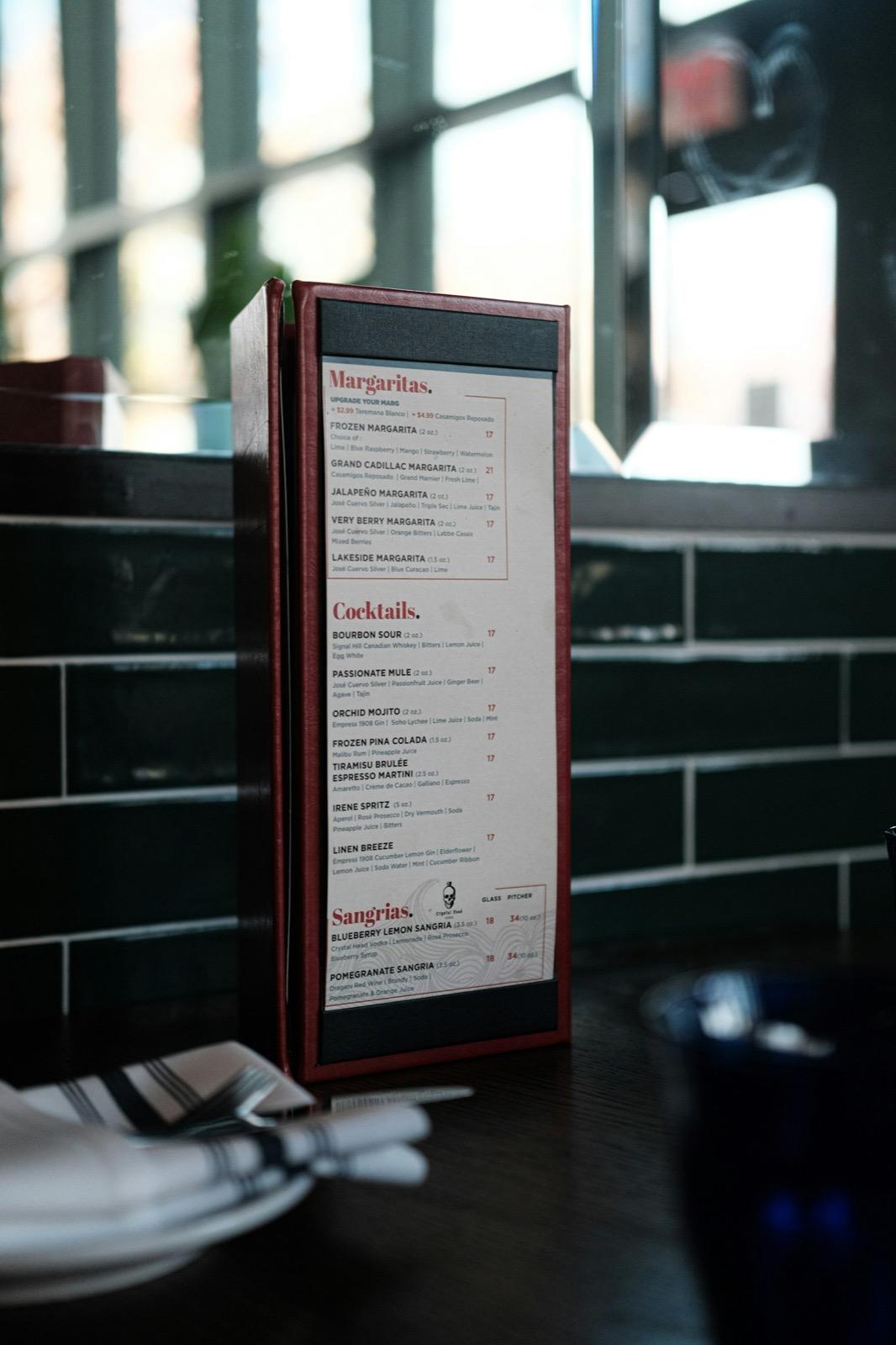
| Text instead of images | Menu as HTML text, not as a scanned PDF or a photo of the chalkboard |
| Alternative texts | Photos of dishes and rooms have a short description |
| Contrast and font size | Easy to read, even on a phone in the beer garden in sunshine; text can be enlarged |
| Keyboard and screen reader | Ordering and reservations work without a mouse and with a screen reader |
| Forms | Every field has a label, errors are explained clearly |
| Time limits | The basket or reservation does not expire after a few seconds |
| Clear language | Clear steps, no unexplained abbreviations; allergens written out, not just as letters |
| Payment | The payment page is also accessible |
This is closely linked to allergen labelling: letter codes such as “A, C, G” mean nothing to anyone without a legend, least of all to screen readers. Our free allergen legend creates a written-out overview for your menu. What allergen information legally requires is explained in our guide Allergen labelling in Austria.
Accessibility statement and information
Under § 14 BaFG and Annex 3, service providers must provide information on how their service meets the accessibility requirements. The annex names the general terms and conditions or a comparable document for this. In practice, the WKO recommends a separate page, for example “Accessibility statement”, linked in the footer. The information must itself be accessible and be kept up to date for as long as you offer the service.
Content of the statement
- General description of the service (e.g. online ordering for pickup)
- Explanation of how the service works and how guests use it
- Description of how the requirements are met (e.g. according to EN 301 549 and WCAG AA)
- Known limitations and alternatives (e.g. ordering by phone)
- Contact for feedback on accessibility
- Reference to the Sozialministeriumservice as the competent authority
- Date of the last review
The statement replaces neither the legal notice (Impressum) nor the privacy policy; it comes on top. Which other mandatory information your website needs is shown in our guide to the Legal notice in Austria; with the legal notice generator, you can create it in a few minutes.
Enforcement, complaints and penalties
Under § 21 BaFG, the competent market surveillance authority is the Sozialministeriumservice (Bundesamt für Soziales und Behindertenwesen). Under § 35 BaFG, consumers can report violations there, as can the Verein für Konsumenteninformation (consumer association), the Österreichischer Behindertenrat (Austrian Disability Council), the Bundesarbeitskammer (Federal Chamber of Labour) and the Wirtschaftskammer. The authority must state within eight weeks whether it is opening proceedings.
| Violation (§ 36 BaFG) | Maximum fine | For micro, small and medium-sized businesses |
|---|---|---|
| Offering or providing a service that is not accessible | 80,000 € | 50,000 € |
| Missing or inadequate information under Annex 3 | 40,000 € | 25,000 € |
| Breach of documentation, reporting and cooperation duties | 16,000 € | 10,000 € |
If you rely on a disproportionate burden under § 18 BaFG, you must assess this yourself using the criteria in Annex 4, document it, repeat it at least every five years and submit information to the Sozialministeriumservice. According to the WKO, lack of time or low priority do not count as reasons. For contracts concluded before 28 June 2025, a transitional period of no more than five years applies; new services must comply immediately.
Why accessibility pays off for every venue
Accessibility sounds like an obligation, but above all it is good hospitality online. A large share of your guests benefit from it without having a disability.
- Older guests find the menu easier to read when the font is large enough and the contrast is right.
- Phones in the sun: in the beer garden or on the street, weak colour contrasts are barely legible.
- A text menu instead of a PDF loads faster, can be translated and is found by Google. More in our guide to the digital menu.
- Tourists use the browser's translation function, which does not work for images and PDFs.
- Clear buttons for reserving and ordering increase the conversion rate for everyone.
How to get it right
- Maintain your menu, opening hours and allergens as text
- Give every photo a short alternative text
- Test ordering and reservations once using only the keyboard
- Ask external tools for their accessibility statement
- Offer a phone number as an alternative to the online process
Better not
- Upload your menu only as a PDF or photo
- Use light grey text on a white background
- Install an “accessibility overlay” and believe that takes care of everything
- Mark required fields only in red
- Use CAPTCHAs without an alternative
Restaurant website with a text menu
Our websites rely on real text, good contrast and clear buttons. See a free preview for your venue.
A free preview of your venue website, designed by us.